The Ultimate Beginners Guide: How to Start Trading Forex from Scratch
So you want to learn Forex from scratch? Lets do it.
This post has one goal only. My goal is to help you start trading and potentially make money on the forex market. By the time you finish reading this, you will know all the basics of the forex market and be fully equipped to place your first trades with confidence.
- What Forex actually is and what it is not.
- How real traders make money in the markets.
- How to choose and create an account with a reliable broker.
- How to use trading platforms like MetaTrader 5.
- Basic Forex terms you absolutely need to know.
- How to place your first trades and calculate your profits.
Once you learn these core concepts, you are good to go and trade on your own. Now lets get going into our first lesson.
Watch the full explanation here
Ready to take action while you learn?
Set up your free practice account with Deriv so you can follow along with the examples in this guide.
Create Your Deriv AccountWhat Exactly is Forex?
When you hear the word Forex, what comes to mind?
Cars, mansions, Instagram gurus flashing a lot of cash? Well, that is what most people think. But lets strip away the noise and break down what this business actually is, and most importantly, how you can make money with it.
Forex is simply the shortcut for Foreign Exchange.
Foreign Exchange means exchanging one currency for another currency. For example, exchanging the US Dollar to the South African Rand, the US Dollar to the Pula, or the USD to the Naira.
You have probably exchanged currency at some point in your life. If you did, then congratulations you are a forex trader already. When two currencies are being exchanged, there is an agreed upon rate with the money changer, right?
If you have ever paid attention, these exchange rates are always changing. The reason they change is due to global supply and demand. Because these rates fluctuate, some people are profiting from it, and some are losing money from it.
If you have been to a bank, you will see a digital board somewhere on the wall with a list of currencies and their current rates. It looks a lot like the chart below.
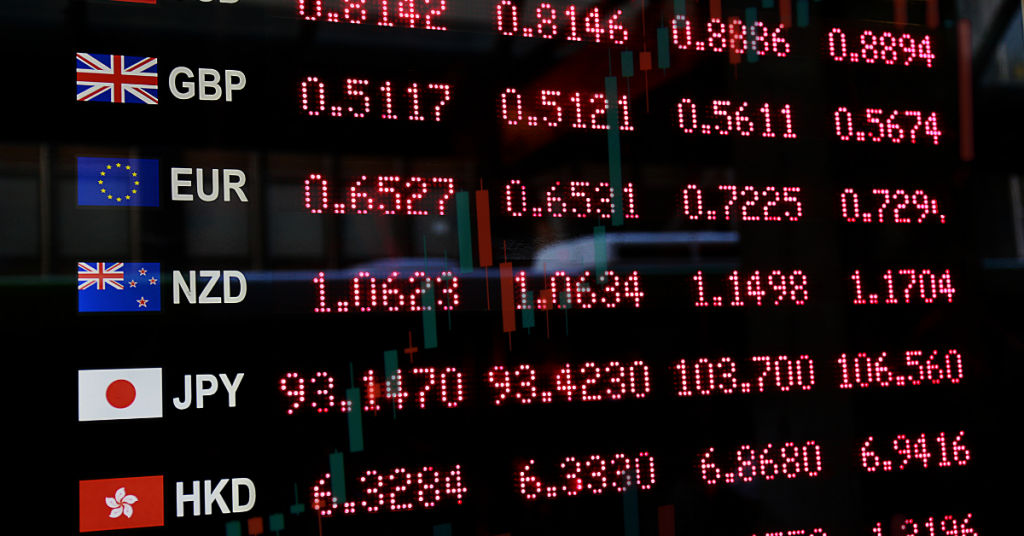
These exchange rates show you how valuable one currency is compared to another. We will talk more about the specifics of these numbers later.
The Bureau de Change Example: How Traders Make Money
Now let me give you a very real, very practical example of how you make money as a trader.
Lets assume that you live in South Africa, you have 50 000 Rands in your bank account, and you want to go to the United States for a vacation with your girlfriend. So, you go to the local Bureau de Change center to exchange your 50 000 Rands into US Dollars.
When you get to the Bureau de Change, they tell you that the exchange rate is USD $1 = ZAR 10.
So that means for your 50 000 Rands, they will hand you $5 000 USD.
You agree, and the deal is done. You just made the first step of trading. In this specific case, you are buying USD using Rands.
Now, three days after that transaction, you catch your girlfriend cheating on you. At this point, you cancel the American trip entirely. You take your $5 000 USD and go right back to the Bureau de Change center to get your Rands back.
When you get there, you look at the board and realize the exchange rate has changed. It is now USD $1 = ZAR 15.
This means for the exact same $5 000 you bought three days ago, you will now sell it at a higher price. The money changer hands you 75 000 Rands.
You started with 50 000 Rands, and you walked away with 75 000 Rands. That is an extra 25 000 Rands in pure profit. Now at this point, do you really even blame your girlfriend for cheating on you? I bet no.
Why Did You Make That Profit?
Lets get back to the mechanics and explain exactly why you made that 25 000 Rands in profit.
Exchange rates are always changing every single day. So as the exchange rate moves up and down, we can make money by buying currencies at a lower price and selling them when the rate rises.
In our example, on Day 1, the exchange rate was 1 to 10. For every 1 dollar, you needed 10 rands. You bought dollars at a lower exchange rate. When the rate rose to 1 to 15, it meant the dollar became stronger. You were holding $5 000, which meant you could sell it back to Rands at that higher rate and pocket the difference.
You can see how simple the core concept is. If it still feels a bit confusing, just reread that Bureau de Change example above until it clicks.
Now, before we move forward, let me make something very clear you do not need to go to a physical Bureau de Change center to trade forex. You also do not need 50 000 Rands to start.
With modern Forex trading, you can trade directly from your smartphone, and you can start from as little as $10. I will show you exactly how to do it. But first, let me explain the arena we are stepping into.
What is the Forex Market?
The Forex Market is the biggest financial market in the entire world. Over 6 trillion dollars is traded every single day. Yes, there is a market moving that much money, and you probably did not even know it was happening right above your head.
The Forex Market is a spot market or a decentralized market. This means it is not tied to one specific physical location like the New York Stock Exchange. Anyone from anywhere in the world can join the market and buy or sell currencies.
The 5 Main Market Players
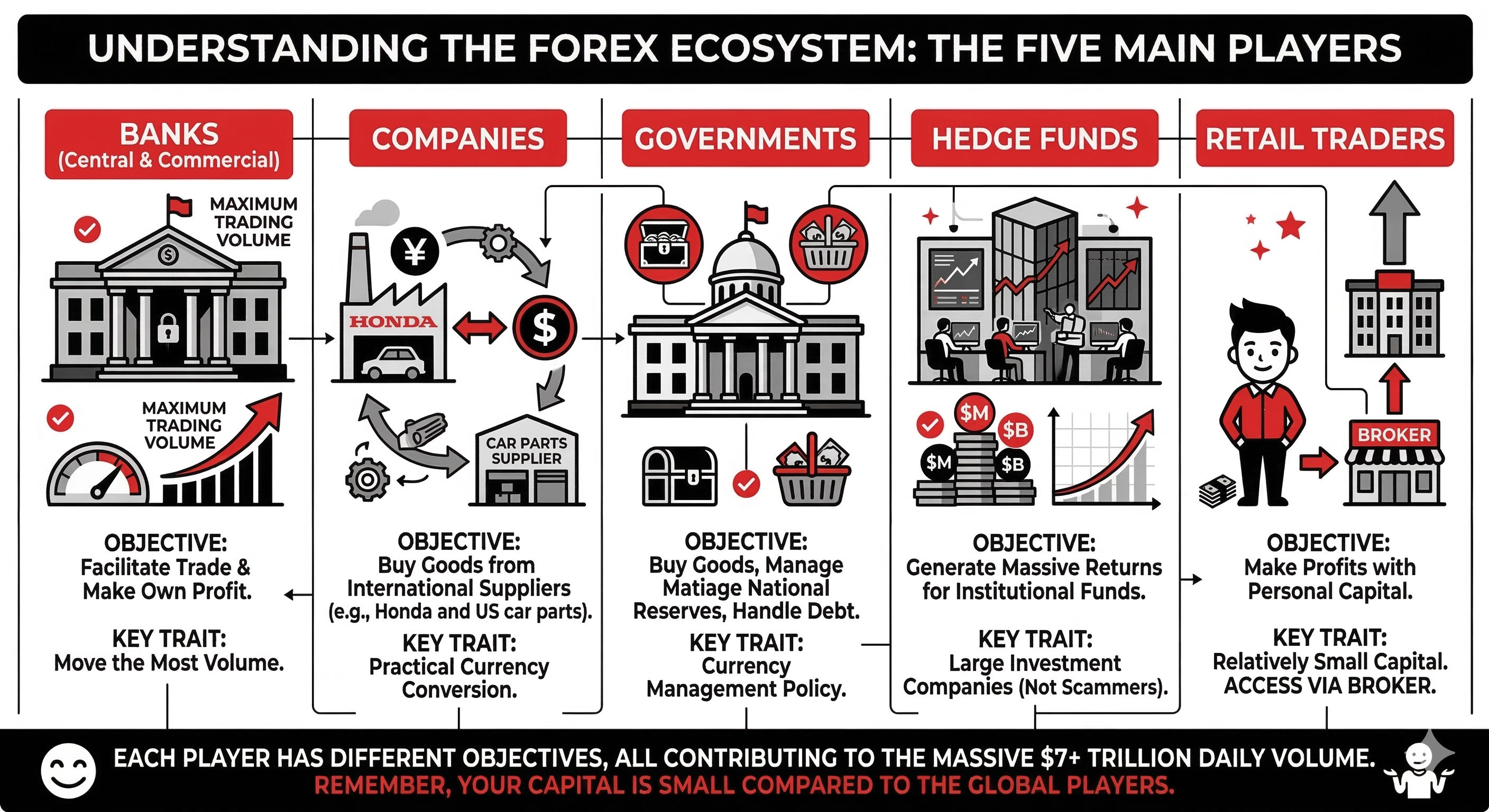
When you place a trade, you are interacting with five main players in this ecosystem:
- Banks: The massive central and commercial banks trade forex for many reasons, including facilitating international trade and making their own profits. They move the most volume.
- Companies: Imagine Honda a Japanese company trying to buy car parts from a supplier in the USA. What do they do? They exchange Japanese Yen to USD so they can complete the transaction easily.
- Governments: When a government needs to buy goods from another country or manage their national reserves, they will need to exchange currencies.
- Hedge Funds: Hedge funds are large investment companies. You can invest your money with them, and they trade that money with the goal of generating massive returns. I am talking about real institutional funds, not the scammers in your DMs who call themselves account managers. These are big companies trading millions or billions.
- Retail Traders: This is you and me. Retail traders enter the market for one reason only to make profits. Because our capital is relatively small compared to banks, we are called retail traders. And as a retail trader, you can only access the live market through a middleman called a broker.
What is a Forex Broker?
To start buying and selling instruments on the forex market, you need to create a trading account with a broker.
A forex broker is a company that connects you to the live market. You trade through their systems. When you want to buy or sell a currency pair, all you have to do is log into the trading platform provided by the broker, and you will execute your trades with the click of a button.
Creating this account is entirely free. In fact, most reputable brokers will give you a virtual account called a demo account loaded with $10 000 or more in fake money to practice with.
This means you can practice trading in real time market conditions without risking a single cent of your own money. When you are consistent and ready to trade real money, you deposit funds into your trading account and go live. The minimum deposit depends on the broker, but many allow you to start with as little as $5 or $10.
Brokers also allow you to trade huge amounts of money even if you do not have it in your account. They do this through a tool called leverage, which we will break down shortly.
How to Choose a Good Broker
Choosing a reliable broker is critical. When you are putting your hard earned money online, you need to be extremely careful to avoid scammers. If you fund an untrusted, unregulated broker, they may simply disappear with your deposits.
Here are the non negotiable things you must look for in a broker before signing up:
- Regulation: Your broker needs to be registered with recognized financial authorities. This ensures they operate fairly and your money is separated from company funds.
- Deposit and Withdrawal Methods: You need a broker that makes it easy to deposit or withdraw your profits at any time. Depending on your country of residence, some brokers only allow Visa or Mastercards. For those of us in Africa, we need brokers that support local e wallets and accessible payment gateways.
- Customer Service: Whenever money is involved, responsive customer care is the most important feature. If a trade glitches or a withdrawal is delayed, you need to speak to a human quickly.
- Experience and Track Record: How long has this broker been operating? How many active users do they have? Longevity in this industry is a great sign of trust.
The Broker I Personally Recommend: Deriv
Ready to take action while you learn?
Set up your free practice account with Deriv so you can follow along with the examples in this guide.
Create Your Deriv AccountThere are hundreds of brokers out there, but the one I personally use and highly recommend is called Deriv.
Deriv is one of the most popular brokers globally, and the main reason I use them is that they focus heavily on traders in Africa and emerging markets. They allow you to deposit and withdraw money easily using most of the e wallets found across the continent.
They have been in the market for 25 years. I have personally attended their live conferences and seen their operations firsthand, which cemented my trust in them as a legitimate, top tier broker.
With Deriv, you are not limited to just currencies. As you grow and learn more about this business, you will likely want to branch out. Deriv allows you to trade Gold, Indices, Commodities, Crypto, and Synthetic Indices all from one single account. They also provide three different trading platforms so you can choose the interface that fits your style best.
To get started, they give you a $10 000 practice account called the Deriv Demo Account. Right now, I want you to create a demo account so that when we start placing trades, you can follow along step by step.
Here is a quick video walking you through exactly how to set up your account properly.
Join My Free Trading Community
Want to see the exact setups I trade every week? Join my free community and get real-time market analysis.
Get Trading Signals HereIntroduction to MetaTrader 5
Once your account is created, it is time to connect it to MetaTrader 5. MetaTrader 5 is the actual software platform you will use to place your trades every single day.
Think of Deriv as your bank, and MT5 as the ATM machine you use to interact with your funds. MetaTrader connects to your brokers account, so every trade you place on MT5 will directly reflect on your account balance.
When you open the MT5 app on your phone, you will notice five main pages or tabs at the bottom. Lets break down what each one does:
- The Quotes Page: This is your home screen. It displays a list of all the currency pairs and their live exchange rates. If you want to trade a pair that isn't listed, you can easily add it here.
- The Charts Page: The charts page is the visual heartbeat of trading. It shows you exactly how the market price has been moving over time. As traders, we use this historical data to analyze patterns and predict future price movements. We cover this heavily in Technical Analysis lessons.
- The Trade Page: This is where the action happens. Here you will see your account balance, equity, and your current running trades. If your open trades are in profit, the numbers turn blue. If you are in a loss, the numbers turn red.
- The History Page: This acts as your trading journal. It shows the results of all your closed trades, your daily profit or loss, and your deposit or withdrawal records.
- The Settings Page: Used for managing your accounts, adjusting chart colors, and modifying app preferences.
Understanding Currency Pairs
When you press buy or sell on MT5, what exactly are you buying or selling?
The answer is simple money. Money has value, and its value fluctuates constantly based on politics, economics, and human behavior. Because it fluctuates, you can buy it at a lower price and sell it at a higher price.
But you cannot just buy money in isolation. You always have to compare it to another currency. This is why currencies are traded in pairs.
A currency pair takes two currencies and measures their exchange rate against each other. For example, lets look at this pair:
USD/ZAR 15.10
This is the United States Dollar paired against the South African Rand.
- The first currency in the pair USD is called the Base Currency.
- The second currency in the pair ZAR is called the Quote Currency.
The number you see 15.10 is the exchange rate. It simply means that 1 unit of the base currency 1 USD is worth 15.10 units of the quote currency 15.10 ZAR.
The Three Categories of Currency Pairs
Currency pairs are divided into categories based on global trading volume.
- Major Pairs: These are the most heavily traded pairs in the world. They always contain the US Dollar paired with another major global currency like EUR, GBP, JPY, CAD. Because so many people trade them, they are very cheap to trade. Examples EUR/USD, GBP/USD, USD/JPY.
- Minor Pairs: These pairs do not include the US Dollar, but they do contain other major global currencies paired together. Examples EUR/GBP, GBP/JPY, EUR/AUD.
- Exotic Pairs: These pair a major currency with the currency of an emerging or smaller economy like the Rand, the Peso, or the Lira. They are highly volatile and more expensive to trade. Example USD/ZAR, USD/MXN.
Bid, Ask, and Spreads Explained
If you look closely at the Quotes page on MT5, you will notice that every currency pair actually has two different exchange rates listed next to it. They are slightly different from each other.
- The first price is the Bid Price. This is the exact price you will get if you hit the SELL button.
- The second price is the Ask Price. This is the exact price you will get if you hit the BUY button.
Why are there two prices? And why is the Ask price always slightly higher than the Bid price?
The difference between these two prices is called the Spread. The spread is basically the brokers commission. Instead of charging you a flat monthly fee to use their platform, the broker takes a tiny cut of every trade you place by keeping the difference between the buy and sell prices.
The Math of Trading: Pips and Lots
Pay very close attention to this section, because this is how we calculate the actual money.
What is a Pip?
A Pip Percentage in Point is the standard unit of measurement for how much an exchange rate has changed. It is the smallest movement that a currency pair can make.
In everyday life, we look at money in two decimal places, like $1.20. But in forex, exchange rates are calculated out to the fourth decimal place, like $1.2025. As traders, we make our money off those tiny micro movements.
A pip is the fourth decimal number of the exchange rate 0.0001.
To calculate how many pips the market has moved, we simply subtract the old price from the new price.
Example 1:
Lets say the exchange rate for EUR/USD moves from 1.2025 to 1.2028.
Math: 1.2028 minus 1.2025 equals 0.0003.
The market moved by 3 pips.
Example 2:
Lets say the exchange rate for GBP/USD moves from 1.0950 to 1.0980.
Math: 1.0980 minus 1.0950 equals 0.0030.
The market moved by 30 pips.
So, the market moves in tiny fractions called pips. But how do we turn a 0.0030 move into real, spendable cash? We do that using Lot Sizes.
What is a Lot Size?
A lot is a bundle of currency units. It determines the volume or size of the trade you are placing. When you place a trade on MT5, you must select your lot size.
There are three main types of lots you need to know:
- The Standard Lot 1.00: This represents 100 000 units of currency. It is a massive trade.
- The Mini Lot 0.10: This represents 10 000 units of currency.
- The Micro Lot 0.01: This represents 1 000 units of currency. This is the smallest trade size you can place, and exactly where beginners with small accounts should start.
How Pips and Lots Equal Profit
Your profit is simply the number of pips the market moved, multiplied by the lot size you used.
Lets go back to our example where the market moved 30 pips. How much money would you make?
- If you used a Standard Lot 1.00, every pip is worth roughly $10.
30 pips multiplied by $10 equals $300 Profit. - If you used a Mini Lot 0.10, every pip is worth roughly $1.
30 pips multiplied by $1 equals $30 Profit. - If you used a Micro Lot 0.01, every pip is worth roughly $0.10.
30 pips multiplied by $0.10 equals $3 Profit.
You have total control. You can input any custom lot size you want based on your account balance. For example, entering 0.05 means you are risking about $0.50 per pip.
Let AI Do The Heavy Lifting
Don't have the time to analyze charts manually? Get the Gold Apex Pro to automate your trading and grow your small account effortlessly.
Get Gold Apex Pro HereLeverage: Trading Money You Do Not Have
You might be sitting there thinking, Bro, I do not have $1 000 to trade a micro lot, let alone $100 000 to trade a standard lot.
Here is the brilliant part about modern retail forex you do not need that much capital. Brokers provide a tool called Leverage.
Leverage acts like a multiplier for your money. Brokers require you to deposit a small margin say $10, and they will allow you to control trade sizes up to 500 times that amount.
With 1 to 500 leverage, your $10 deposit gives you the buying power of $5 000. Your $100 deposit gives you the buying power of $50 000. That is how retail traders with small accounts can place trades in a global market.
But what does the broker get out of this? Why would they lend you that buying power? It is risk free for them because your profits and losses are strictly tied to your actual account balance.
Lets say you have a $100 account balance, and you use leverage to place a huge Standard Lot trade where every pip is $10.
If the market moves 10 pips in your direction, you just made $100. You doubled your account in seconds.
But, if the market moves 10 pips against you, you just lost your entire $100 account. Because you have no more real money to cover the losses, the broker will automatically close the trade to protect themselves. This is called blowing your account.
Leverage is a double edged sword. It can build wealth rapidly, but without proper risk management, it can destroy your capital just as fast.
Putting It All Together: The 2 Ways to Make Money
Unlike a traditional stock portfolio where you only make money if a company grows, in Forex, you can profit whether the market is going up or going down.
- Buying or Going Long: You analyze the chart and predict the exchange rate will rise. You click BUY. You are buying at a low price, waiting for the chart to go up, and then closing the trade to sell at a high price. You keep the profit.
- Selling or Going Short: You analyze the chart and predict the exchange rate will fall. You click SELL. You are locking in a high price now, waiting for the market to drop, and buying it back at a cheaper rate to close the trade. You pocket the difference.
Of course, if your prediction is wrong because if you buy and the market drops, or you sell and the market rises you will lose money on that trade.
Ready to take action while you learn?
Set up your free practice account with Deriv so you can follow along with the examples in this guide.
Create Your Deriv AccountConclusion and Next Steps
We just covered a lot of ground. Lets do a quick recap of the key takeaways:
- Forex is the buying and selling of global currencies to profit from changing exchange rates.
- You access this 6 trillion dollar market through a broker, and I highly recommend Deriv for their reliability and low entry barriers.
- You place your actual trades on an app called MetaTrader 5.
- Profits and losses are calculated in Pips, and your risk is managed by your Lot Size.
- Leverage allows you to trade big positions with a small account balance, but it must be respected.
All of this theory makes total sense, but it becomes ten times easier the moment you actually press the buttons yourself. Reading about driving a car is completely different from getting behind the wheel.
Your immediate next step is practice. Go ahead and open your demo account right now, connect it to MT5, and place your very first practice trade. Click buy, click sell, change the lot sizes, and watch how the numbers move. Do not worry about strategy yet just get comfortable with the tools.
Join Deriv Today
Don't wait. Set up your account with the most reliable broker in Africa right now.
Create Your Account HereYou have taken the first huge step towards mastering this skill. Keep learning, protect your capital, and lets get to work.